Some of my favorite teaching moments happen after the students leave.
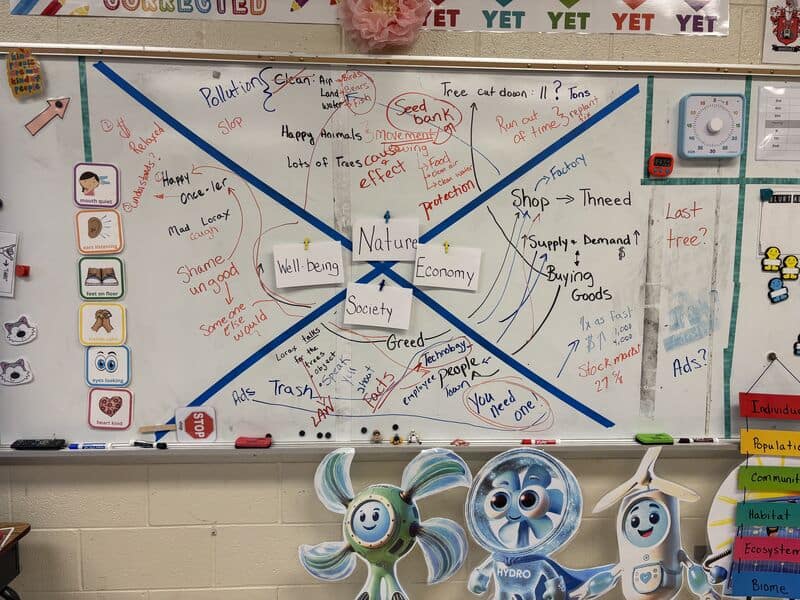
This week, my 5th graders watched part of The Lorax and answered one question: Could the Lorax have done more for the trees?
The overwhelming answer was yes. But the conversation that stuck with me didn’t happen during class. It happened after.
The Lesson
We used the Sustainability Compass to map out what was actually happening in the story. Nature, Society, Economy, Well-being. Students started connecting ideas across all four. The Lorax speaking for the trees. The Once-ler’s greed. Supply and demand. What gets lost when the last tree falls.
By the end, the board looked like… a lot. Arrows everywhere. Ideas branching off ideas. Connections looping back on themselves.
It was, by any normal classroom standard, a mess.
The Moment
As the students filed out, the general education teacher looked at the board and said, “Well, that is a mess!”
I smiled and said, “Thanks for noticing. Sustainability education is all about embracing the mess.”
She laughed and walked away. And I stood there for a second, taking it in.
Because here’s the thing. She wasn’t wrong about what she saw. But she was seeing it through a different lens. A messy board in most classrooms means something went sideways. In a systems thinking lesson, a messy board means students were actually thinking.
Zooming in to see the individual pieces. Zooming out to see the bigger picture. Holding both at the same time. That’s not a clean process. It was never supposed to be.
What the Mess Actually Means
Systems thinking asks students to sit with complexity. To notice that pulling one thread moves something else. To resist the urge to oversimplify a problem that isn’t simple.
That kind of thinking doesn’t produce tidy notes. It produces boards that look exactly like the one behind me.
Ready to lead your students on this exciting trail map?
Take a look at some blogs that can bring sustainability into your classroom.
Miss Makey: Turning Trash to Treasure