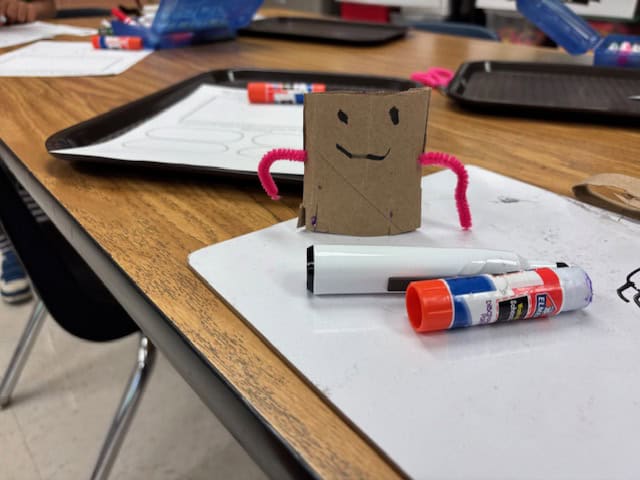
There’s nothing quite like that lightbulb moment when a student realizes they can transform seemingly worthless “trash” into “treasure”. If you’re looking for a lesson that sparks creativity, fosters collaboration, and seamlessly integrates STEM with sustainability, then allow me to introduce you to one of my absolute favorites: the Miss Makey and the Magic Bin challenge!
This lesson, perfect for grades 3-5, is an absolute hit with students. They adore the freedom to create, and as a teacher, I love how it encourages them to think about resourcefulness and innovation through the lens of sustainability. It’s a truly magical way to introduce complex ideas in a fun, accessible format.
Miss Makey and the Magic Bin: The Book That Starts It All
Before diving into the design challenge, we begin with a read-aloud of the book, “Miss Makey and the Magic Bin” by Mandi Figlioli. The story introduces students to Miss Makey, a curious and imaginative teacher, and her “Magic Bin” – a bin filled with what others might see as junk, but she sees as potential. The book encourages readers to look at everyday items with new eyes and imagine the possibilities for creation. It’s the perfect springboard for getting students to embrace the idea that “waste” can be a valuable resource.
Engineering Design Process: Your Classroom Blueprint
This lesson is also a fantastic way to introduce or reinforce the Engineering Design Process (EDP). The EDP is a structured approach that engineers use to solve problems, mirroring how creative thinkers often work. It’s not always a linear path, but a cycle of:
- Ask: What is the problem? What are the constraints?
- Imagine: Brainstorm solutions.
- Plan: Draw a detailed design.
- Create: Build your prototype.
- Improve: Test, reflect, and redesign.
By guiding students through these steps, you’re building foundational STEM skills that will serve them far beyond this lesson.
How to Implement Your Own “Magic Bin” Challenge
Here’s how I typically roll out this engaging, multi-day project:
Day 1: Sparking Ideas and Planning Phase
- Read the Book: Gather your students and read “Miss Makey and the Magic Bin” aloud. Emphasize Miss Makey’s curious spirit and her ability to see potential in discarded items.
- Introduce Your “Magic Bin”: Have a large bin of clean, random recyclable items (e.g., a few cardboard tubes, a plastic bottle, an egg carton, a small box) at the front of the classroom.
- Whole-Class Brainstorm: Pick out 3-4 random items from your magic bin. Ask the class, “What could we make with just these items?” Guide them through the initial EDP steps as a class:
- Ask: What’s our challenge? (To create something new from these items.)
- Imagine: Brainstorm different ideas together. Encourage “wild” ideas!
- Plan: Briefly discuss how they might combine these items.
- Individual/Small Group Exploration: Send students back to their tables where they will find their own “Magic Bin” filled with a variety of clean recyclables (e.g., cereal boxes, plastic containers, bottle caps, paper towel rolls, fabric scraps, aluminum foil, old CDs).
- Explore & Plan: Instruct students to explore the materials in their bin. Encourage them to pick up items, feel their textures, and imagine what they could become. Then, have them draw a plan for their invention. They should sketch their design and add notes to remember their initial ideas and what materials they plan to use. This is their blueprint!
Day 2: Create and Iterate
- Build Time! Have students use their plans from Day 1 to create their inventions. Before they begin, offer an important piece of engineering wisdom: “It’s okay to change your plan!” Explain that sometimes, a day away from an idea can inspire new thoughts, upgrades, or even a complete change of direction.
- Embrace the Challenge: This is a fantastic time to discuss perseverance. Remind students that not everything works as planned on the first try. Encourage them to embrace challenges, troubleshoot problems, and learn to reimagine their ideas when something doesn’t go quite right.
- Reflection (if time allows): Towards the end of the day, if time permits, have students reflect on their process. What went well? What challenges did they face, and how did they overcome them? Did their plan change, and why?
Day 3 (Optional): Share and Inspire
- Invention Showcase: Have students present their inventions to the class. Encourage them to explain their idea, how it works, and what recycled materials they used.
- Inspire and Connect: This presentation day is a powerful opportunity to discuss how other people’s ideas can inspire us. Students can see diverse solutions to the same challenge and appreciate the creativity of their peers. It also highlights the power of collaboration and sharing.
A Note for Struggling Innovators: Fostering “Outside the Box” Thinking
Some students might find open-ended challenges a bit daunting at first, especially if they’re used to more structured tasks. It’s okay! Patience is key.
- Be Patient with the Process: Creative thinking takes time. Some students need a longer “imagine” phase, even if it looks like they’re just staring at the bin. Avoid rushing them.
- Open-Ended Questions: Instead of giving solutions, try questions like: “What does this remind you of?” “How could you connect these two pieces?” “What problem could this solve?” “What if you turned it upside down?”
- Scaffolding, Not Solutions: Offer a very gentle nudge, not a full answer. “Could this piece be a wheel, or something else entirely?” Or, “Tell me about what you’re thinking so far, even if it’s not a full idea yet.”
- Encourage Exploration: Remind them it’s okay to try things that don’t work. The learning is in the trying!
Interested in Learning More About Sustainable STEM?
Take a look at some of the other blogs based on Sustainability in the Classroom.