In my last post, I shared that I’ve moved beyond the survival phase of teaching and into what I call my why phase. I started asking deeper questions about what sustainability education truly means in an elementary setting.
That reflection led me here.
As a K–5 sustainable energy teacher who sees every student in the school once a week, I don’t have the luxury of treating sustainability as a one-off lesson or a yearly theme. It has to make sense across grades. It has to build. And most importantly, it has to mean something to kids.
Through research, classroom experience, and a lot of iteration, I’ve been working toward a clear, usable framework for sustainability education…one that teachers can actually lean on, not just admire.
Why a Framework Matters
One of the biggest gaps I see in sustainability education is structure. Too often, it shows up as scattered moments: a recycling lesson, an Earth Day activity, a quick connection to a science unit. Those moments matter, but they don’t always add up.
Sustainability education is about systems, patterns, and long-term thinking. Without a framework, students may learn about sustainability without understanding how ideas connect or how their choices fit into the bigger picture.
I needed something that:
- Worked across grades K–5
- Honored child development
- Encouraged action without skipping understanding
- Supported outdoor and real-world learning
That’s where this framework began to take shape.
Know. Explore. Lead.
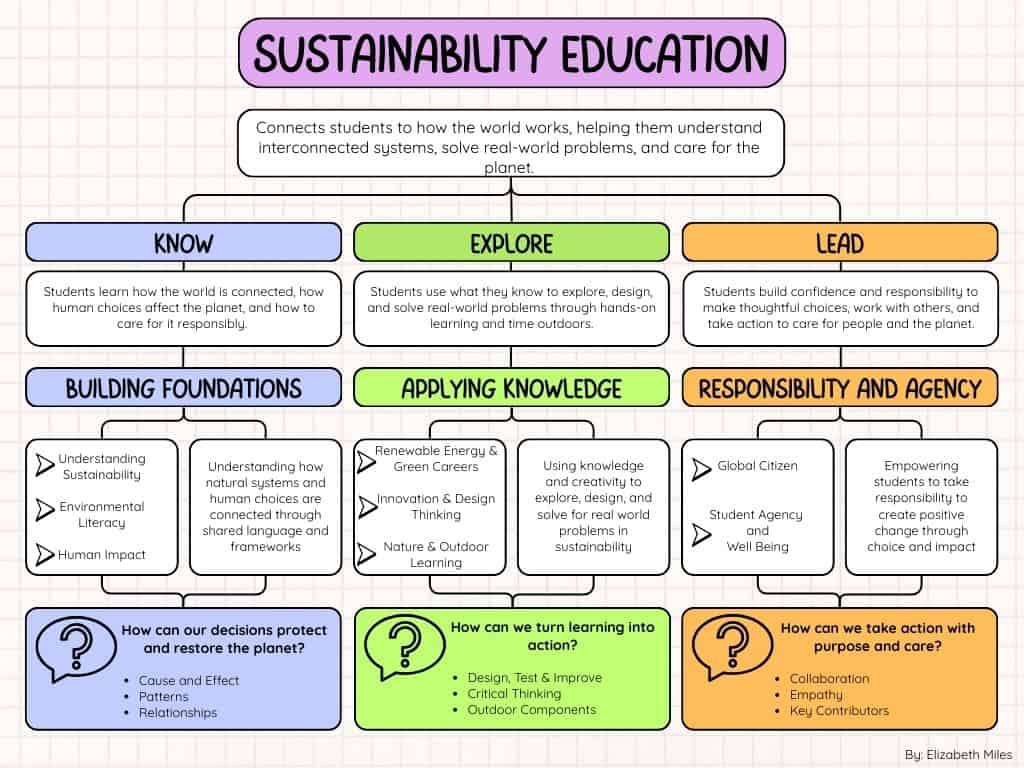
At the core of this framework are three interconnected pillars: Know, Explore, and Lead. These are not rigid stages, but guiding lenses that help shape learning experiences over time.
Know – Building Foundations
This is where students develop environmental literacy and understand how the world works. They learn how human choices affect natural systems and begin to recognize patterns, cause and effect, and relationships. The driving question here is simple but powerful:
How can our decisions protect and restore the planet?
Explore – Applying Knowledge
This is where learning becomes active. Students use what they know to explore real-world problems through design thinking, outdoor learning, renewable energy concepts, and exposure to green careers. Exploration turns knowledge into experience and asks:
How can we turn learning into action?
Lead – Responsibility and Agency
Leadership in sustainability doesn’t mean grand gestures; it means thoughtful choices. In this pillar, students build confidence, empathy, collaboration skills, and a sense of responsibility. They begin to see themselves as contributors and ask:
How can we take action with purpose and care?
What This Looks Like in Practice
This framework helps sustainability education move beyond “doing projects” and toward building thinkers. It gives teachers language, direction, and flexibility while still leaving room for creativity and local context.
Most importantly, it supports what I believe is the heart of sustainability education: helping students understand why their choices matter, and empowering them to care enough to act.
This framework is still evolving, shaped by students, questions, and classroom reality. If you’re curious about the why behind this work, you can read my previous post [linked here].
This is the work I’m deeply invested in, and I’m excited to keep building it alongside other educators.
Ready to lead your students on this exciting trail map?
Take a look at some blogs that can bring sustainability into your classroom.
Miss Makey: Turning Trash to Treasure